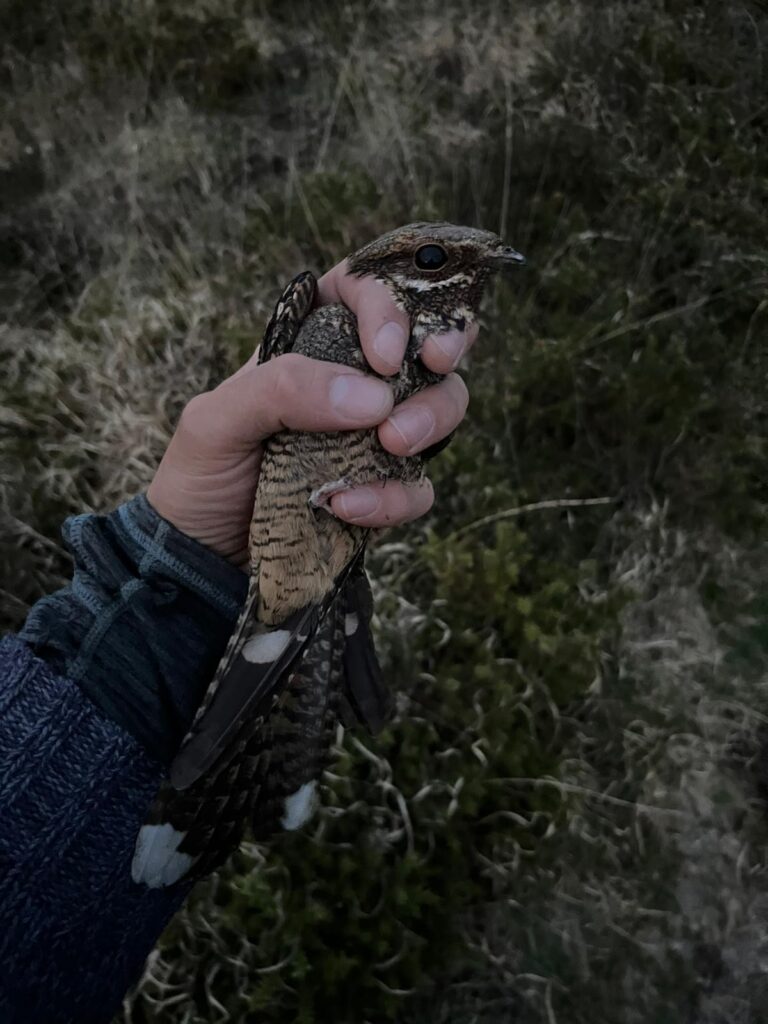
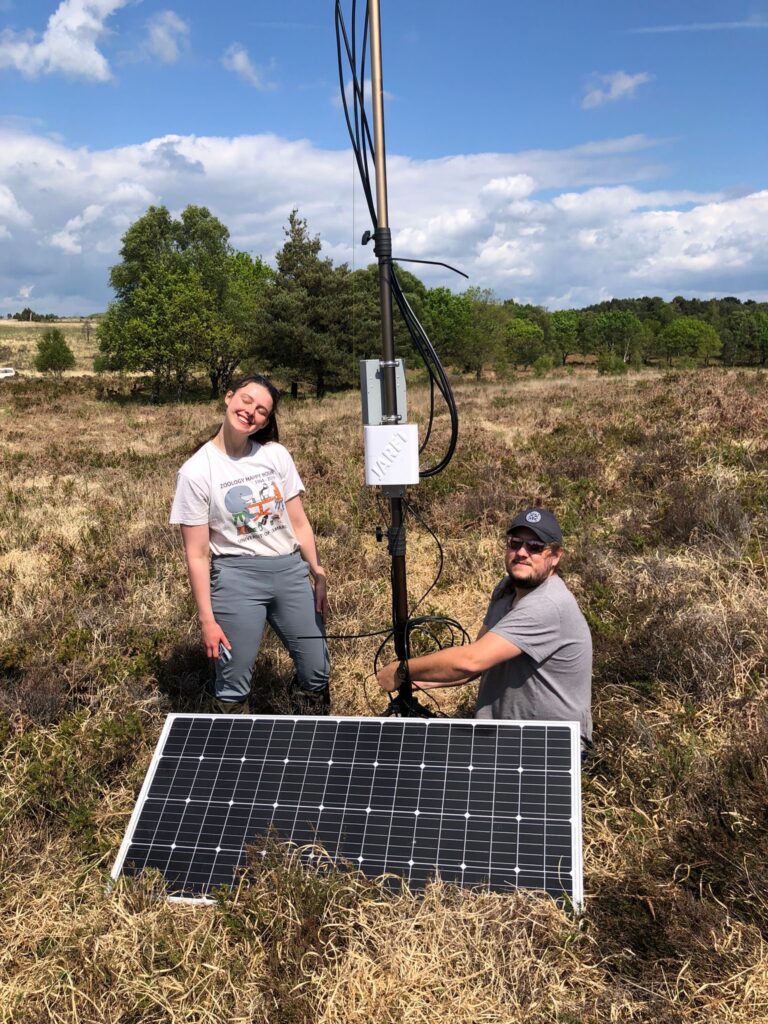
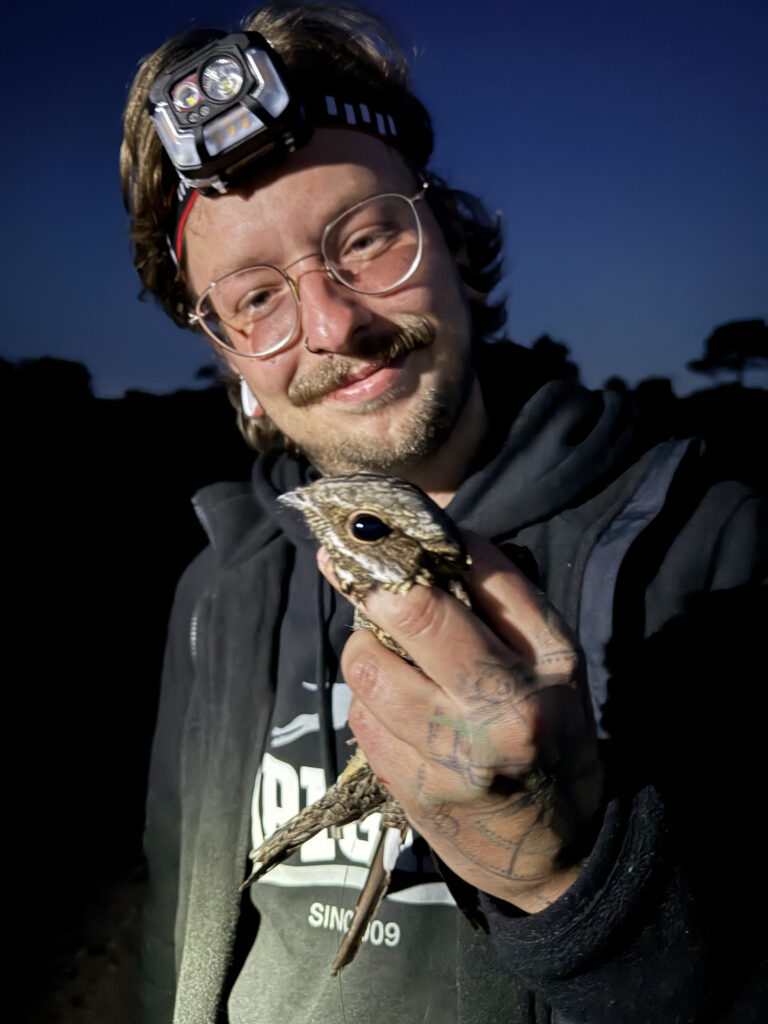
Photos on the left and in the center: University of Liverpool Photo on the right: trackIT systems
Automated Radio Telemetry on the Nightjar (Caprimulgus europaeus) in Great Britain
Manual radio telemetry in the field is time-consuming, labor-intensive, and often reaches its limits when dealing with rapid movement patterns. A research project at the University of Liverpool, led by Dr. Oliver Padget, is using our automated radio-tracking system to study the foraging and breeding behavior of the European nightjar in a heathland landscape in Dorset (United Kingdom).
The goal is to document and analyze the birds’ movement patterns and social interactions as comprehensively as possible. At the same time, we are collaborating on the project with Lotek, one of the world’s leading companies in the field of wildlife tracking, to jointly develop new transmitters for the trackIT system.
How the trackIT system helps answer researchers’ questions
To study complex behaviors such as social interactions, telemetry data with high temporal resolution and the greatest possible spatial precision is required.
- Our vhf:tracker-directional is currently the only system available worldwide that provides this data in real time with relatively little installation effort.
- The system continuously records position data, enabling automated tracking of tagged individuals. This significantly reduces the effort required for manual cross-bearing measurements, and movement data is immediately available for analysis.
- Practical experience from the project: By the midpoint of the field season, 15 birds were already active in the system. According to the project team, the continuous availability of location data facilitates both the localization of nests and the targeted recapture of tagged individuals.
- Analysis of social interactions: The high temporal and spatial resolution enables the study of interactions between individuals, which often cannot be fully captured using conventional manual telemetry.
Curious? The accompanying animation from the University of Liverpool, created last year, illustrates the movement patterns of four birds tracked using our system:
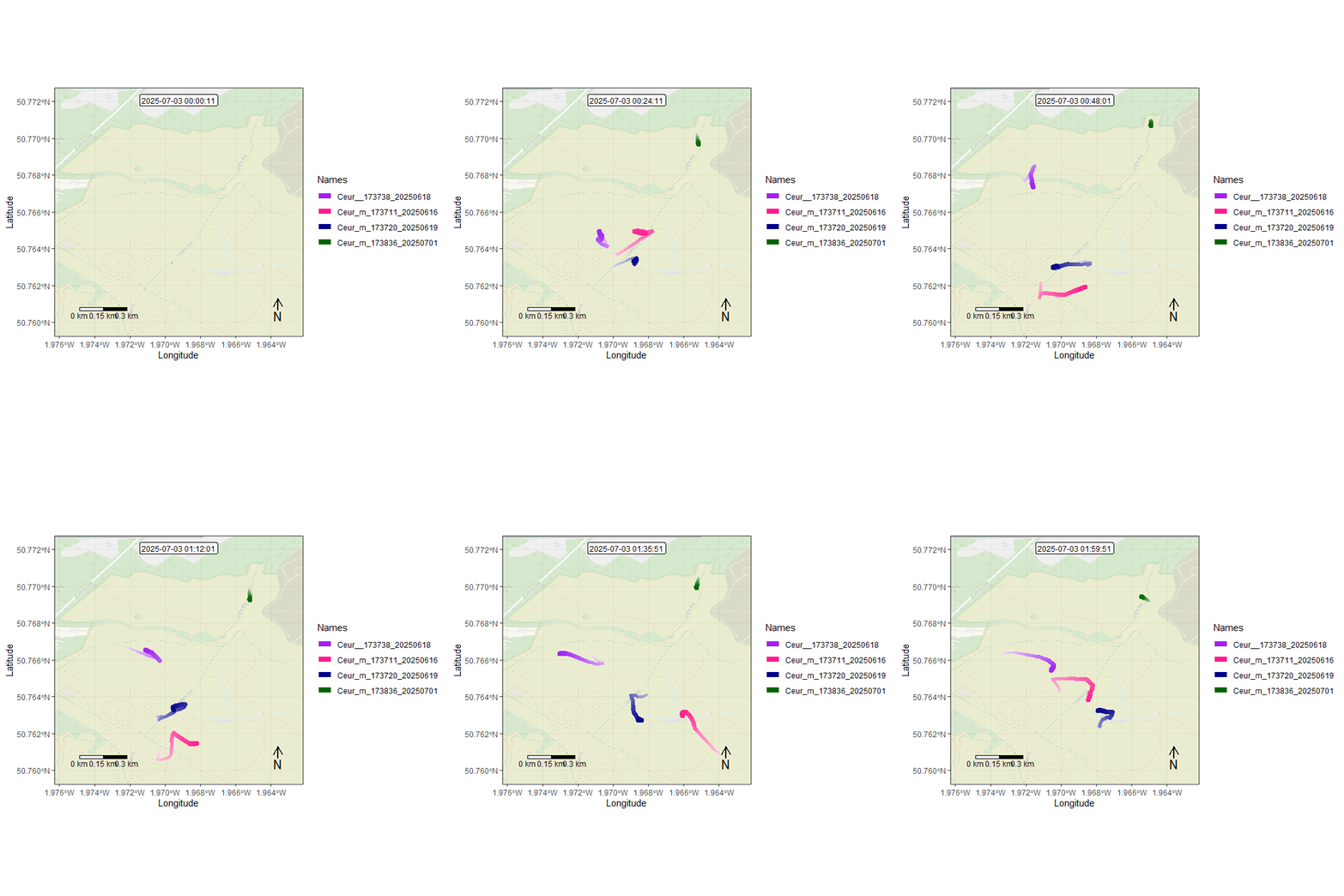
Copyright: University of Liverpool
Applications in Research, Monitoring, and Intervention Procedures
The automated radio telemetry system supports the collection of telemetry data in research, monitoring, and intervention procedures. Continuous, automated data collection reduces the workload in the field and generates standardized data sets. The scientific evaluation of the results remains the responsibility of the researchers. The system serves as a tool for data collection and reduces the workload, particularly for time-consuming routine tasks.
If you have any questions about possible applications or planning a project, we’d be happy to assist you. Simply contact us by email or via the contact form on our website.
Would you like to receive our newsletter once a month? In it, you’ll get a glimpse into our “Project of the Month,” learn about new products, and discover tips and updates. You can sign up for the newsletter here.